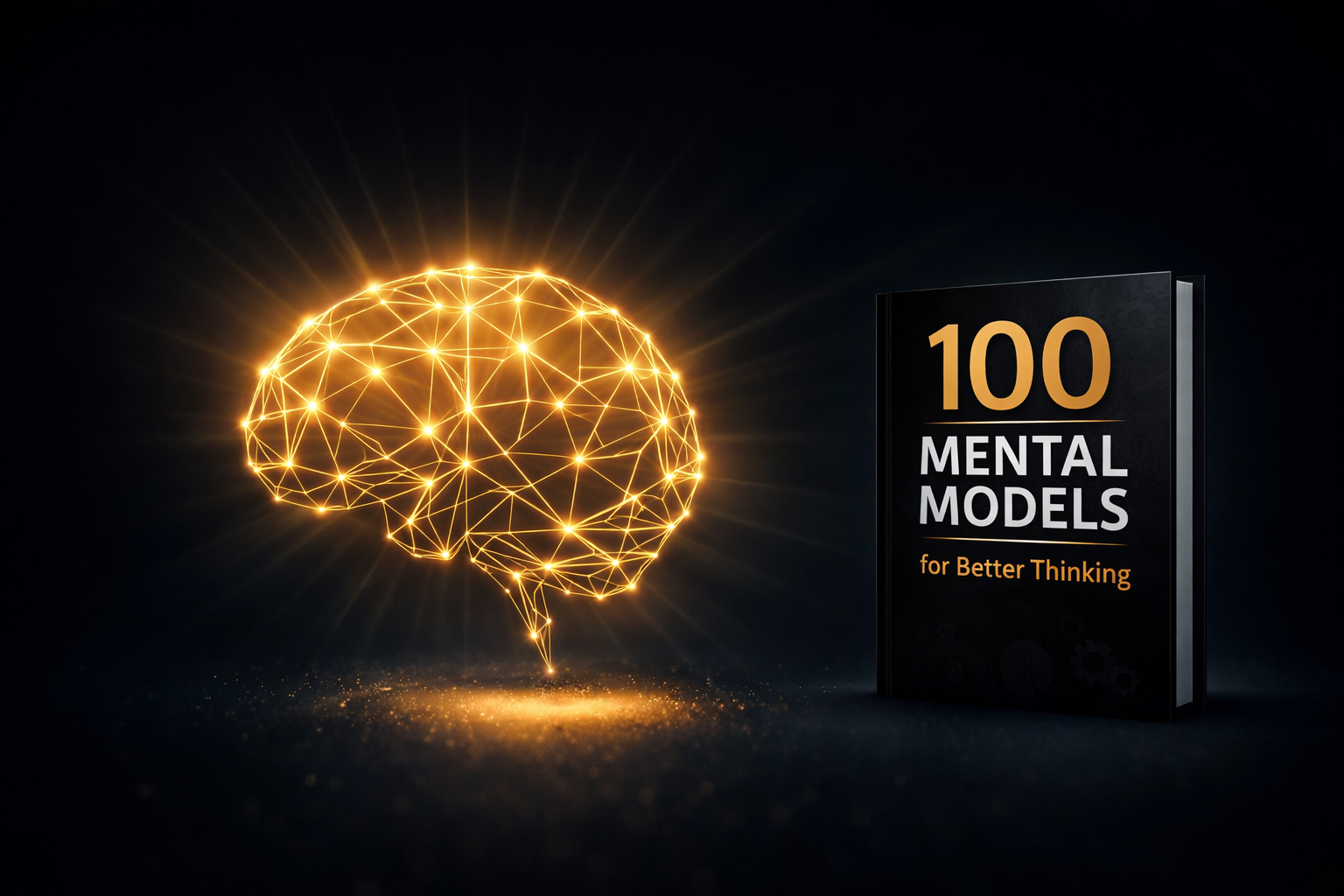
Why I Wrote "100 Mental Models for Better Thinking"
Mental Models
104 posts
I didn’t plan to write this book.
A few years ago, I started a small project on my blog called The Daily Concept. The idea was simple: take one concept at a time and try to understand it well enough to actually use it. Not just definitions, but something practical. Something you could apply the next time you had to make a decision, build something, or figure out what really matters.
Like many side projects, it slowly faded.
But the underlying problem never went away.
If anything, it got worse.
We now live in a world where answers are everywhere. You can ask an AI almost anything and get something that sounds convincing in seconds. Feeds are full of opinions, summaries, frameworks, takes. But despite all of that, it’s still surprisingly easy to make bad decisions, miss obvious things, or get trapped in flawed thinking.
More information didn’t fix the problem. It just made the noise louder.
That’s the real reason I wrote this book.
I wanted to go back to the idea behind The Daily Concept, but do it properly this time. Take the most useful mental models I’ve come across over the years and put them in one place, in a way that’s actually usable.
Not as a collection of definitions, but as a thinking toolkit.
The book covers 100 mental models across different areas: decision-making, psychology, systems, risk, incentives, markets, and long-term thinking. Things like First Principles Thinking, Opportunity Cost, Second Order Effects, Feedback Loops, Survivorship Bias, and many others.
For each one, the goal is simple: understand how it works, where it helps, where it breaks, and how it shows up in real life. Business, technology, personal decisions, everyday situations.
Because most mistakes don’t come from a lack of intelligence. They come from using the wrong lens, or not realizing which lens you’re using at all.
What I’ve found over time is that having a small set of good mental models changes how you see things. Patterns become more visible. Tradeoffs become clearer. You start asking better questions. And once you see something clearly, it’s hard to go back.
This book won’t make decisions for you. That’s not the point.
But it can give you better tools to think with.
And in a world that’s getting faster, noisier, and more automated, that might be one of the few advantages that still compounds.
If you want a practical toolkit for clearer thinking, better decisions, and seeing the world through stronger lenses, you can get the book here:
👉 Get 100 Mental Models for Better Thinking on Amazon
Key Takeaways
- This post explains the motivation behind writing the book and reviving The Daily Concept idea.
- Core idea: better thinking requires better mental models, not more information.
- The book is designed as a practical toolkit for decision-making in a noisy, AI-driven world.
Quick Q&A
Why did you write this book?
To revive The Daily Concept project and create a practical toolkit for thinking clearly in an age of information overload.
What is the main value of the book?
It provides 100 mental models that help improve decision-making, clarity, and understanding across different domains.
Part of 104 in
Mental Models